Scott Lord on the Silent Film of Greta Garbo, Mauritz Stiller, Victor Sjostrom as Victor Seastrom, John Brunius, Gustaf Molander - the Golden Age of Swedish Silent Film........Lost Films in Found Magazines: Victor Seastrom directing John Gilbert and Lon Chaney, the printed word offering clues to deteriorated celluloid, extratextual discourse illustrating how novels were adapted to the screen; the photoplay as a literature, a social phenomenon; how it was reviewed, audience reception.
Scott Lord on Silent Film
Gendered spectatorship notwithstanding, in a way, the girl coming down the stairs is symbolic of the lost film itself, the unattainable She, idealized beauty antiquated (albeit it being the beginning of Modernism), with the film detective catching a glimpse of the extratextural discourse of periodicals and publicity stills concerning Lost Films, Found Magazines
Tuesday, September 30, 2025
Scott Lord Silent Film: The Heart of a Hero (Chataurd, 1916)
Actress Gail Adams played the lead in the six reel film The Heart of a Hero about a Man Without a Country directed in 1916 by Emile Chautard and scripted by Frances Marion.
Silent Film
Greta Garbo Victor Sjostrom Silent Film
Scott Lord on Silent Film, Scott Lord on Swedish Film, Scott Lord on Mystery Film
at
11:37:00 PM
No comments:
Greta Garbo Victor Sjostrom Silent Film
Scott Lord,
Scott Lord Silent Film,
Silent Film,
Silent Film 1916
Scott Lord on Silent Film, Scott Lord on Swedish Silent Film, Scott Lord on Danish Silent Film
Scott Lord Silent Film: A Fool There Was (Powell, 1915)
Silent Film


Directed by Frank Powell for the Fox Film Corporation, "A Fool There Was" (six reels) introduced actress Theda Bara to the audiences of 1915. The film also stars actresses Mabel Frenyoen and May Allison.
It is one of the only surviving films in which Theda Bara appeared, of the almost fourty films in which the actress appeared between 1916 and 1919, including "Camille" and "Madame Du Barry", only three minutes of footage survivive, nearly every single film in which she appeared on screen now presumed lost, with no existing copies.
Theda Bara wrote "How to Become a Vampire" for the June 1919 issue of Forum magazine and was interviewed by Olga Petrova for Shadowland magazine in 1922 and for Motion Picture Magazine in 1922, both instances of one actor interviewing another. Theda Bara married film director Charles Brabin in 1921, who that year was directing actress Estelle Taylor in the film "Footfalls" (eight reels).
"A Fool There Was" was remade during 1922 by director Emmett J Flynn and starred acress Estelle Taylor.
Silent Film
Silent Film


Directed by Frank Powell for the Fox Film Corporation, "A Fool There Was" (six reels) introduced actress Theda Bara to the audiences of 1915. The film also stars actresses Mabel Frenyoen and May Allison.
It is one of the only surviving films in which Theda Bara appeared, of the almost fourty films in which the actress appeared between 1916 and 1919, including "Camille" and "Madame Du Barry", only three minutes of footage survivive, nearly every single film in which she appeared on screen now presumed lost, with no existing copies.
Theda Bara wrote "How to Become a Vampire" for the June 1919 issue of Forum magazine and was interviewed by Olga Petrova for Shadowland magazine in 1922 and for Motion Picture Magazine in 1922, both instances of one actor interviewing another. Theda Bara married film director Charles Brabin in 1921, who that year was directing actress Estelle Taylor in the film "Footfalls" (eight reels).
"A Fool There Was" was remade during 1922 by director Emmett J Flynn and starred acress Estelle Taylor.
Silent Film
Silent Film
Greta Garbo Victor Sjostrom Silent Film
Scott Lord on Silent Film, Scott Lord on Swedish Film, Scott Lord on Mystery Film
at
11:37:00 PM
No comments:
Greta Garbo Victor Sjostrom Silent Film
Scott Lord,
Scott Lord Silent Film,
Silent Film,
Silent Film 1915
Scott Lord on Silent Film, Scott Lord on Swedish Silent Film, Scott Lord on Danish Silent Film
Monday, September 29, 2025
Scott Lord Silent Film: William Shakespeare
Greta Garbo Victor Sjostrom Silent Film
Scott Lord on Silent Film, Scott Lord on Swedish Film, Scott Lord on Mystery Film
at
1:20:00 AM
No comments:
Scott Lord on Silent Film, Scott Lord on Swedish Silent Film, Scott Lord on Danish Silent Film
Scott Lord Silent Film: Edgar Allan Poe’s Annabel Lee
Greta Garbo Victor Sjostrom Silent Film
Scott Lord on Silent Film, Scott Lord on Swedish Film, Scott Lord on Mystery Film
at
12:01:00 AM
No comments:
Scott Lord on Silent Film, Scott Lord on Swedish Silent Film, Scott Lord on Danish Silent Film
Sunday, September 28, 2025
Scott Lord Silent Film: Walt Whitman and Free Verse
Although Walt Whitman and Emily Dickinson may, as writers of Free Verse, be considered the forerunners of Modernism, The Silent Film Era would become known for it exciting new school of poetry Imagism and its margins with poets Robert Frost, Amy Lowell, T.S. Eliot, Carl Sandburg and Ezra Pound, silent films that may have not propagated Dadaism, but did aquaint themselves with Art Deco.
Silent Film
Silent Film
Greta Garbo Victor Sjostrom Silent Film
Scott Lord on Silent Film, Scott Lord on Swedish Film, Scott Lord on Mystery Film
at
11:59:00 PM
No comments:
Scott Lord on Silent Film, Scott Lord on Swedish Silent Film, Scott Lord on Danish Silent Film
Saturday, September 27, 2025
Scott Lord Silent Film: Lon Chaney in Outside the Law (Tod Browning, 1920)
"Outside the Law" (eight reels), directed by Tod Browning during 1920, was coscripted by Browning with Gardner Bradford and Lucien Hubbard and photographed by William Fildew. The films stars Lon Chaney and actress Priscilla Dean. Advertisements placed in the periodical Motion Picture News annouced Leo McCarey as first executive assistant to Tod Browning, whom it credited with not only being the film's director but its "Author". The Film Daily reviewed its direction as being "uniformly excellent" but its story as lacking stregnth although lifted by its actors Lon Chaney and Pricilla Dean.
The later film, "Outside the Law" was directed by Tod Browning during 1930 but has different characters than the earlier film, his having coscripted the film with Garret Fort. The film was photographed by Roy Overbaugh and starred actress Mary Nolan. Lon Chaney Lon Chaney Silent Film
Greta Garbo Victor Sjostrom Silent Film
Scott Lord on Silent Film, Scott Lord on Swedish Film, Scott Lord on Mystery Film
at
6:32:00 AM
No comments:
Greta Garbo Victor Sjostrom Silent Film
Lon Chaney,
Silent Film 1920
Scott Lord on Silent Film, Scott Lord on Swedish Silent Film, Scott Lord on Danish Silent Film
Scott Lord Silent Film: Lon Chaney in The Penalty (Wallace Worsely, 1920)
After having directed he seven reel silent Film “The Penalty” In 1920, Wallace Worsely would direct Lon Chaney in “The Ace of Hearts” and “Voices of the City”,costarring Leatrice Joy during 1921.

Lon Chaney
Lon Chaney Silent Film Lon Chaney
Greta Garbo Victor Sjostrom Silent Film
Scott Lord on Silent Film, Scott Lord on Swedish Film, Scott Lord on Mystery Film
at
6:27:00 AM
No comments:
Greta Garbo Victor Sjostrom Silent Film
Lon Chaney,
Lon Chaney Wallace Worsley,
Scott Lord Silent Film,
Silent Film,
Silent Film 1920
Scott Lord on Silent Film, Scott Lord on Swedish Silent Film, Scott Lord on Danish Silent Film
Friday, September 26, 2025
Scott Lord Silent Film: Mary Pickford in Suds (Dillon, 1920)
Silent Film


John Francis Dillon directed Mary Pickford in the film "Suds" (six reels) for the Mary Pickford Company during 1920.
Silent Film Silent Film


John Francis Dillon directed Mary Pickford in the film "Suds" (six reels) for the Mary Pickford Company during 1920.
Silent Film Silent Film
Greta Garbo Victor Sjostrom Silent Film
Scott Lord on Silent Film, Scott Lord on Swedish Film, Scott Lord on Mystery Film
at
3:28:00 PM
No comments:
Greta Garbo Victor Sjostrom Silent Film
Mary Pickford,
Scott Lord,
Scott Lord Silent Film,
Silent Film,
Silent Film 1920
Scott Lord on Silent Film, Scott Lord on Swedish Silent Film, Scott Lord on Danish Silent Film
Wednesday, September 24, 2025
The Haunted House (Buster Keaton, Edward Cline, 1921)
Buster Keaton and Eddie Cline began the decade by directing two reel comedies, including The High Sign", "The Boat", "The Playhouse" and "Hard Luck" during 1921. silent film
Greta Garbo Victor Sjostrom Silent Film
Scott Lord on Silent Film, Scott Lord on Swedish Film, Scott Lord on Mystery Film
at
8:20:00 AM
No comments:
Greta Garbo Victor Sjostrom Silent Film
Silent Film 1921
Scott Lord on Silent Film, Scott Lord on Swedish Silent Film, Scott Lord on Danish Silent Film
Scott Lord Silent Film: Lili Dagover in The Cabinet of Dr. Caligari (Rob...
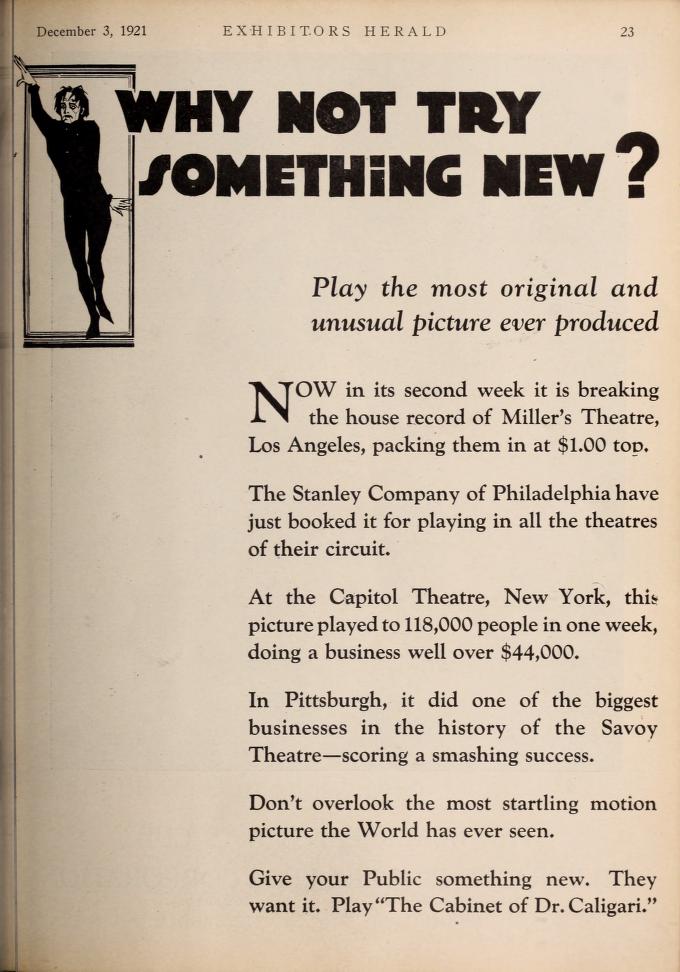
Arthur Knight, in his volume The Liveliest Art, views "The Cabinet of Dr. Calgari" as one of the most famous silent films ever made. Knight explains, "Two things distinguished 'Caligari' as a film: the daring of the story-within-a-story and the startling originality of its decor." Knight implies the thematic elements are articulated in the mise-en-scene of the film, remarking upon its "obviously 'artistic' settings (related nith to the stage work of the expressionists and to the experiments of the cubist painters". Leo Braudy, in his volume The World in a Frame, gives The Cabinet of Caligari, directed by Robert Wiene during 1921, as an example of a "closed film", where the director creates his own space, a unique and specific diegetic backdrop, as opposed to an "open film" where the story finds it own enviornment in which events are to take place. Not only is characterization what allows narrativity, but where the stage us set allows theme and mood to carry the storyline.
Silent Horror Film
Silent Horror Film
Silent Horror Film Movie Posters
Greta Garbo Victor Sjostrom Silent Film
Scott Lord on Silent Film, Scott Lord on Swedish Film, Scott Lord on Mystery Film
at
8:17:00 AM
No comments:
Greta Garbo Victor Sjostrom Silent Film
Silent Film,
Silent Film 1921,
Silent Horror Film
Scott Lord on Silent Film, Scott Lord on Swedish Silent Film, Scott Lord on Danish Silent Film
Scott Lord Silent Film: Tale of Two Cities (Frank Lloyd, 1917)
Already a remake of a 1911 Tale of Two Cities directed by Charles Kent, the seven reel 1917 film adaptation directed by Frank Llyod for the Fox Film Corporation starred William Farnum in a dual role.
Scott Lord
Silent Film
Scott Lord
Silent Film
Greta Garbo Victor Sjostrom Silent Film
Scott Lord on Silent Film, Scott Lord on Swedish Film, Scott Lord on Mystery Film
at
12:05:00 AM
No comments:
Greta Garbo Victor Sjostrom Silent Film
Scott Lord Silent Film,
Silent Film,
Silent Film 1917
Scott Lord on Silent Film, Scott Lord on Swedish Silent Film, Scott Lord on Danish Silent Film
Saturday, September 20, 2025
Scott Lord Silent Film: The Country Doctor (D.W. Griffith, Biograph, 1909)
One technique used to present narrative by D.W. Griffith, although the principle thematic action was two interior scenes connected by cutting on action, was to introduce the film with an exterior panning shot as the establishing shot. The film is concluded with a similar exterior shot which pans in the opposite direction to imply the story had reached an irrevocable conclusion.
Written and directed by D.W. Griffith for the Biograph Film Company the film stars Gladys Egan, Mary Pickford, Florence Lawrence and Kate Bruce.
The periodical The Moving Picture World reviewed the film, "The heart dramas which have come from Biograph studio have been numerous but perhaps none has been stronger, nor has there been one which has made the profound impression which is made by this one. Ordinarily, the gloom which accompanies death seems needless in a picture play, not where a drama great moral truth as this one does, perhaps it should be accepted as indicating the right view of life rather than as amusement."
D.W.Griffith
D.W. Griffith Biograph Film Company
Written and directed by D.W. Griffith for the Biograph Film Company the film stars Gladys Egan, Mary Pickford, Florence Lawrence and Kate Bruce.
The periodical The Moving Picture World reviewed the film, "The heart dramas which have come from Biograph studio have been numerous but perhaps none has been stronger, nor has there been one which has made the profound impression which is made by this one. Ordinarily, the gloom which accompanies death seems needless in a picture play, not where a drama great moral truth as this one does, perhaps it should be accepted as indicating the right view of life rather than as amusement."
D.W.Griffith
D.W. Griffith Biograph Film Company
Greta Garbo Victor Sjostrom Silent Film
Scott Lord on Silent Film, Scott Lord on Swedish Film, Scott Lord on Mystery Film
at
12:06:00 AM
No comments:
Greta Garbo Victor Sjostrom Silent Film
D.W. Griffith,
Mary Pickford,
Scott Lord Silent Film,
Silent Film,
Silent Film Biograph Film Company
Scott Lord on Silent Film, Scott Lord on Swedish Silent Film, Scott Lord on Danish Silent Film
Monday, September 8, 2025
Scott Lord Silent Film: Mary Pickford in Amarilly of Clothes Line Alley (Neilan, 1918)
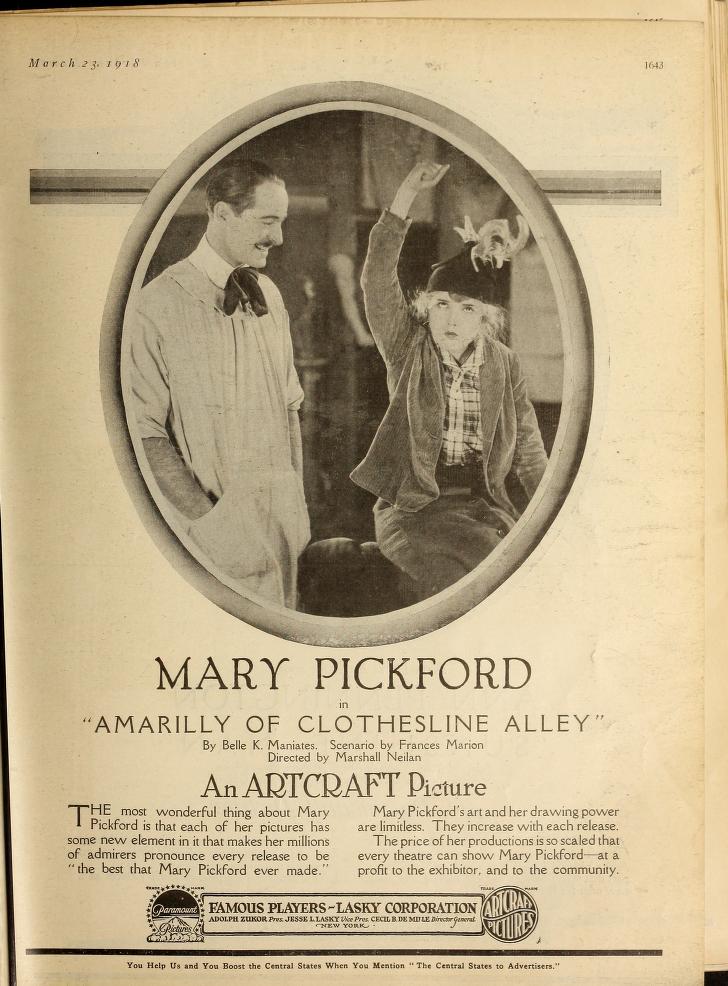
During 1918, Mary Pickford starred in the five reel film "Amarilly of Clothesline Alley", directed by Marshall Neilan with a photoplay scripted by Frances Marion and Bellek Maniates. Actress Margaret Landis also appears in the film. Photoplay Magazine likened the the acting of Mary Pickford in the film to her work in Stella Maris in its being a "remarkable" character study. "All this is done in Mary Pickford's blithest vein, reminding us once more that she is the greatest of all screen actresses." The competition, Picture Play Magazine, afforded the view of a different angle. "This is Mary Pickford's latest, and it contrasts strongly with that highly dramatic subject, "Stella Maris". It is almost entirely in a humorous vein, though there are times when one catches a glimpse of pathos in the character of Amarilly. But there are more laughs than tears."
In a later photocaption, Photoplay Magazine again revealed that this was for Mary Pickford, recognizable commodity, the portrayal of a new character. (Mary Pickford is shown looking at the rushes with director Marshall Neilan, who evidently would have been joining the War to end all wars in Europe had an armistice not occurred.) Silent Film Mary Pickford
Greta Garbo Victor Sjostrom Silent Film
Scott Lord on Silent Film, Scott Lord on Swedish Film, Scott Lord on Mystery Film
at
12:45:00 AM
No comments:
Greta Garbo Victor Sjostrom Silent Film
Mary Pickford,
Silent Film,
Silent Film 1918
Scott Lord on Silent Film, Scott Lord on Swedish Silent Film, Scott Lord on Danish Silent Film
Saturday, September 6, 2025
Swedish Silent Film Stars on the Theater Stage
Maurtiz Stiller
During 1911, Mauritz Stiller acted on stage at the Lilla Teaten. Mauritz Stiller Mauritz Stiller Swedish Silent Film Stars
Greta Garbo Victor Sjostrom Silent Film
Scott Lord on Silent Film, Scott Lord on Swedish Film, Scott Lord on Mystery Film
at
7:18:00 PM
No comments:
Greta Garbo Victor Sjostrom Silent Film
Mauritz Stiller,
Scott Lord Swedish Silent Film,
Swedish Silent Film Stars on the Theater Stage
Scott Lord on Silent Film, Scott Lord on Swedish Silent Film, Scott Lord on Danish Silent Film
Scott Lord Silent Film: A Narrow Escape (Pathe, 1908)
"A Narrow Escape" is evidently the only film in which both the doubling narrative, or bifidation narrative, used in crosscutting and the last minute rescue were present before their use in the films of D.W. Griffith. Scholar Phillipe Gauthier has noted that crosscutting had been present in the film "The One Hundred to One Shot" made by Vitagraph in 1906. D. W. Griffith used crosscutting frequently to depict the last minute rescue frequently during the beginning of 1909, particulalrly in the film "The Lonely Villa". The director at Biograph had been Wallace McCutcheon (Personal,1904) and it is him to whom, rightly or not, crosscutting has been attributed (Her First Adventure,1906;The Elopement,1907); on occaision directors were beginning to hint at cutting on action by 1907 and were also beginning to link scenes together, as when the same character appears in two scenes that are adjacent.
Author Tom Gunning, in his volume D.W. Griffith and the origins of Narrative Film, likens The Lonely Villa to "A Narrow Escape", only to descry D.W. Griffith's having developed its elementary techniques into a more narratively integrated work. "'A Narrow Escape' creates suspense through parallel editing, using the pattern tocreate an agonizing delay....which is a direct prefiguration of the narrator system." Gunning sees the techniques appearing in "The Lonely Villa" as only haing briefly appeared in "The Narrow Escape", included among those habing been a "three-pronged editing pattern" around which centered its principal characters. "Indebted although it may be, Griffith's film elaborates on the Pathe pattern through further articulation."
If within a cinema of attractions narrative exposition had previously used a discontinuous style, one of filming a single action within what was then an autonomous shot, it would acquire as form a continuous style; where there were to be juxtapositions within narrative from shot to shot, there would be decisions of editing used for the advancement of plot. Technique would become the ordering of images within an arrangement of shots that would bring seperate compositions into a relation with narrative-the film technique that would be later described by Christian Metz as consisting of syntagmatic categories, technique that would avail questioning whether a segment would be autonomous, chrological, linear, narrative or descriptive, chronological, linear, narrative or descriptive, continuous or whether it would be organized, was beginning to be decided. Metz in fact had viewed the narrative function in cinema as being what had brought about its development, it being more possible that the techniques developed by Ince and Griffith. Narrative would no longer need to be only linear in regard to its structure and the syntax of the film could include transitions between scenes: technique, in part could become the attraction. In fact, Roger Manvell quotes an author who credits Griffith with developing the "cinematic or conjunctive" method of narrative, where the tempo of "continuity movement" was accelerated.
During 1908, The Pathe studio, Societe Pathe Freres, founded by Charles Pathe in 1896, performed a magic trick exactly opposite of the break from non-narrative by the cinema of attractions and the temporalities being adapted by narrative form; while George Melies continued toward his 1912 Conquest of the Pole", Pathe invented the newsreel that was to be shown with cartoons and short subjects. Newsreels went to London during 1910 under the name Pathe's Animated Gazette. The temporality created by Segundo de Chemon in the Pathe film "The House of Ghosts" would become friendly competition for the immediacy of royal coronations being filmed as they happened, a diegesis of reality. Screen time transpired just outside the theater, based on an event, if not reverting to an earlier form of attraction. Perhaps at the core of the cinema of attractions are the actuality films of American Mutoscope and Biograph, despite Edison's choosing subjects which could be filmed theatrically indoors, including his film of Annie Oakley shooting. Crosscutting and D.W. Griffith Silent Film
Author Tom Gunning, in his volume D.W. Griffith and the origins of Narrative Film, likens The Lonely Villa to "A Narrow Escape", only to descry D.W. Griffith's having developed its elementary techniques into a more narratively integrated work. "'A Narrow Escape' creates suspense through parallel editing, using the pattern tocreate an agonizing delay....which is a direct prefiguration of the narrator system." Gunning sees the techniques appearing in "The Lonely Villa" as only haing briefly appeared in "The Narrow Escape", included among those habing been a "three-pronged editing pattern" around which centered its principal characters. "Indebted although it may be, Griffith's film elaborates on the Pathe pattern through further articulation."
If within a cinema of attractions narrative exposition had previously used a discontinuous style, one of filming a single action within what was then an autonomous shot, it would acquire as form a continuous style; where there were to be juxtapositions within narrative from shot to shot, there would be decisions of editing used for the advancement of plot. Technique would become the ordering of images within an arrangement of shots that would bring seperate compositions into a relation with narrative-the film technique that would be later described by Christian Metz as consisting of syntagmatic categories, technique that would avail questioning whether a segment would be autonomous, chrological, linear, narrative or descriptive, chronological, linear, narrative or descriptive, continuous or whether it would be organized, was beginning to be decided. Metz in fact had viewed the narrative function in cinema as being what had brought about its development, it being more possible that the techniques developed by Ince and Griffith. Narrative would no longer need to be only linear in regard to its structure and the syntax of the film could include transitions between scenes: technique, in part could become the attraction. In fact, Roger Manvell quotes an author who credits Griffith with developing the "cinematic or conjunctive" method of narrative, where the tempo of "continuity movement" was accelerated.
During 1908, The Pathe studio, Societe Pathe Freres, founded by Charles Pathe in 1896, performed a magic trick exactly opposite of the break from non-narrative by the cinema of attractions and the temporalities being adapted by narrative form; while George Melies continued toward his 1912 Conquest of the Pole", Pathe invented the newsreel that was to be shown with cartoons and short subjects. Newsreels went to London during 1910 under the name Pathe's Animated Gazette. The temporality created by Segundo de Chemon in the Pathe film "The House of Ghosts" would become friendly competition for the immediacy of royal coronations being filmed as they happened, a diegesis of reality. Screen time transpired just outside the theater, based on an event, if not reverting to an earlier form of attraction. Perhaps at the core of the cinema of attractions are the actuality films of American Mutoscope and Biograph, despite Edison's choosing subjects which could be filmed theatrically indoors, including his film of Annie Oakley shooting. Crosscutting and D.W. Griffith Silent Film
Greta Garbo Victor Sjostrom Silent Film
Scott Lord on Silent Film, Scott Lord on Swedish Film, Scott Lord on Mystery Film
at
12:52:00 AM
No comments:
Greta Garbo Victor Sjostrom Silent Film
Silent Film,
The Grammar of FIlm
Scott Lord on Silent Film, Scott Lord on Swedish Silent Film, Scott Lord on Danish Silent Film
Friday, September 5, 2025
Scott Lord Silent Film: Lonely Villa (D.W. Griffith, Biograph, 1909)
In her autobiography, Lillian Gish discusses D.W. Griffith's use of shot length in "The Lonely Villa". Linda Arvidson wife of D.W. Griffith, in her autobiography "When the Movies Were Young" claims that "The Lonely Villa" was the second film in which Mary Pickford had appeared, her having made her motion picture debut in the earlier "The Violin Maker of Cerona". Mack Sennett had gleaned the plot to "The Lonely Villa" from a newspaper.
Author Stanley J. Solomon, in his volume The Film Idea sees "The Lonely Villa" as only the beginning of the development of new film techniques by D.W. Griffith, almost intimating that there would be a synthesis of Griffith as an autuer and new developments in filmmaking would combine. "Although Griffith was working now with materials that could not be effectively duplicated onstage, 'The Lonely Villa' was not really totally cinematic. Griffith's understanding of spatial relationships was still limited; to get a person from one point to another, Griffith shows him moving there in stages." The passage is particularly refreshing because through it Solomon imparts to us where the title of his volume The Film Idea comes from and how it is his point of departure. He writes,"But Griffith learned quickly that a meaningful narrative must be embedded in a total film idea. Otherwise, when the surface movement is the whole film idea, the camera functions simply as a recording device and most of its expressive possiblilities are relegated to either unimportance or mere technique."
In her volume her volume D.W. Griffith, American film master, Iris Barry sees the film technique used by D. W. Griffith developed quickly during a short period of time, "In The Lonely Villa many scenes begin quietly with the entrance of the characters into the set, significant action follows this slow-paced start only belatedly. In The Lonedale Operator there is no leisurely entrance, the characters are already in mid-action when each shot begins and there is no waste footage- no deliberation in getting on with the story when haste and excitement are what is needed." Barry adds, "At no time did he use a scenario. But there was considerable protest when, quite early in his directorial career, he insisted on retaking unsatisfactory scenes and succedded in gaining permission to do so in The Lonely Villa. Bitzer and others were aghast at his extravagence with film."
Film historian Arthur Knight explains in his volume The Liveliest Art, "the legnth of time a shot remained on the screen could create very real psychological tensions in the audience: the shorter the shot, the greater the excitement. As early as 1909, he introduced this principle to build a climax of suspense in 'The Lonely Villa'....By cutting back and forth, from one to the other, making each shot shorter than the last, Griffith heightened the excitement of the situation."
Author Tom Gunning, in his volume D.W. Griffith and the Origins of Ammerican Narrative Film points out that D.W. Griffith had brought another innovation to film while at the Biograph Film Company, "The Lonely Villa" was comprised of a total of 52 seperate shots, compared to European film d'art that may have contained under 10. "The suspenseful parallel editing of 'The Lonely Villa' yeilded fifty-two shots from the twelve camera set-ups".
Adventures of Dollie: D.W. Griffith for the Biograph Film Company D. W. Griffith Biograph Film Company Biograph Film Company
Author Stanley J. Solomon, in his volume The Film Idea sees "The Lonely Villa" as only the beginning of the development of new film techniques by D.W. Griffith, almost intimating that there would be a synthesis of Griffith as an autuer and new developments in filmmaking would combine. "Although Griffith was working now with materials that could not be effectively duplicated onstage, 'The Lonely Villa' was not really totally cinematic. Griffith's understanding of spatial relationships was still limited; to get a person from one point to another, Griffith shows him moving there in stages." The passage is particularly refreshing because through it Solomon imparts to us where the title of his volume The Film Idea comes from and how it is his point of departure. He writes,"But Griffith learned quickly that a meaningful narrative must be embedded in a total film idea. Otherwise, when the surface movement is the whole film idea, the camera functions simply as a recording device and most of its expressive possiblilities are relegated to either unimportance or mere technique."
In her volume her volume D.W. Griffith, American film master, Iris Barry sees the film technique used by D. W. Griffith developed quickly during a short period of time, "In The Lonely Villa many scenes begin quietly with the entrance of the characters into the set, significant action follows this slow-paced start only belatedly. In The Lonedale Operator there is no leisurely entrance, the characters are already in mid-action when each shot begins and there is no waste footage- no deliberation in getting on with the story when haste and excitement are what is needed." Barry adds, "At no time did he use a scenario. But there was considerable protest when, quite early in his directorial career, he insisted on retaking unsatisfactory scenes and succedded in gaining permission to do so in The Lonely Villa. Bitzer and others were aghast at his extravagence with film."
Film historian Arthur Knight explains in his volume The Liveliest Art, "the legnth of time a shot remained on the screen could create very real psychological tensions in the audience: the shorter the shot, the greater the excitement. As early as 1909, he introduced this principle to build a climax of suspense in 'The Lonely Villa'....By cutting back and forth, from one to the other, making each shot shorter than the last, Griffith heightened the excitement of the situation."
Author Tom Gunning, in his volume D.W. Griffith and the Origins of Ammerican Narrative Film points out that D.W. Griffith had brought another innovation to film while at the Biograph Film Company, "The Lonely Villa" was comprised of a total of 52 seperate shots, compared to European film d'art that may have contained under 10. "The suspenseful parallel editing of 'The Lonely Villa' yeilded fifty-two shots from the twelve camera set-ups".
Adventures of Dollie: D.W. Griffith for the Biograph Film Company D. W. Griffith Biograph Film Company Biograph Film Company
Greta Garbo Victor Sjostrom Silent Film
Scott Lord on Silent Film, Scott Lord on Swedish Film, Scott Lord on Mystery Film
at
11:33:00 PM
No comments:
Greta Garbo Victor Sjostrom Silent Film
D. W. Griffith,
Silent Film 1909,
Silent Film Biograph Film Company,
Silent Film D.W. Griffith
Scott Lord on Silent Film, Scott Lord on Swedish Silent Film, Scott Lord on Danish Silent Film
Subscribe to:
Comments (Atom)