
Scott Lord on the Silent Film of Greta Garbo, Mauritz Stiller, Victor Sjostrom as Victor Seastrom, John Brunius, Gustaf Molander - the Golden Age of Swedish Silent Film........Lost Films in Found Magazines: Victor Seastrom directing John Gilbert and Lon Chaney, the printed word offering clues to deteriorated celluloid, extratextual discourse illustrating how novels were adapted to the screen; the photoplay as a literature, a social phenomenon; how it was reviewed, audience reception.
Scott Lord on Silent Film

Gendered spectatorship notwithstanding, in a way, the girl coming down the stairs is symbolic of the lost film itself, the unattainable She, idealized beauty antiquated (albeit it being the beginning of Modernism), with the film detective catching a glimpse of the extratextural discourse of periodicals and publicity stills concerning Lost Films, Found Magazines
Showing posts with label Silent Horror Film. Show all posts
Showing posts with label Silent Horror Film. Show all posts
Monday, November 2, 2026
Scott Lord Silent Film: The Golem, How He Came into the World (Paul Wegener, 1920)
Exhibitor's Herald during 1921 praised the film "The Golem" (Der Golem) for its "ingenious handling of the masses engaged in many of the scenes, persons numbering in the thousands", claiming, "the point of direction and composition" was a "splendid piece of work". It also added, "The lighting, photography and general detail is lacking, and the characters, many of them, are over done in make-up."
Author Lotte H. Eisner, in his volume "The Haunted Screen", explains the contemporaneity of "The Golem", "Paul Wegener always denied having had the intention of making an Expressionist film with his Golem. But that has not stopped people from calling it Expressionist." Seeing the film as an import, or "art film"- an idea particularly important to Scandinavian film companies during that decade almost up to the departure of Charles Magnusson from Swedish Biograph, and therefore an idea frequent in the extratextural film discourse of film critics and reviewers- Picture Play Magazine during 1921 also compared "THe Golem" to "Doctor Caligari" and the theater of Max Reinhardt in its having translated to the screen "the immense imaginative possiblities of the futurist school of dramatic expression". That year periodical highlighted the film with a two page photo dislay, each photo taking up half a page, explaining that "sensational success is predicted" while introducing the "foeign made film", "one of the most important European productions". The photocaptions pointed out the films "curious haunting beauty." The British peridical Pictures and Picturegoer during 1923 did in fact approach genre theory by combining then recent early examples of the mystery thriller, including John Barrymore in his appearance in Dr. Jeckyll and Mr. Hyde, in the article Macabre Movies, distinguishing "The Golem" as a "picturization of a mediaeval legend" but comparing its "Cubist scenery" with that of "Doctor Caligari" with its half-lit ineteriors.
Wegener had given a lecture during 1916 entitled "The Artistic Possibilities of Cinema" as a proponent of "cinematic lyricism" where lines would appear then change as moving surfaces.
Motion Picture World, rather, during 1921 chose to begin with the film's "subject matter" and its "preposteruous story". "He has grasped the most essential fact about his duties as a director- to tell a story in action and develop characters at the same time. Every foot of film advances the progress of the story. There are no cutbacks, no halts for bits of local color or parenthetical description of any of the characters. He knows the meaning of the word drama."
The periodical Motion Picture News during 1921 noted, "Wegener deserves double credit for he also plays the tile role and makes it an unforgettable figure."
Paul Wegener wrote,directed and starred in the his first adaptation of the novel "The Golem" in 1915, presumed to be almost entirely lost with only fragments surviving. Henri Galeen co-wrote and co-directed the photoplay exhibited as "Monster of Fate" in the United States, where Wegener appeared in the 1926 film "The Magician", directed by Rex Ingram.
Author Kenneth Macgowan, in his volume Behind the Screen, inaccurately credits Stellan Rye, director of the 1913 film "The Student of Prague", as having directed "The Golem" by complimenting his collaboration with screenwriter Henrik Galeen. Macgowan writes," Key light and shadow, the selection and composition of scenes, and above all, a script that progressed clearly, logically and imaginatively, these men created one of those motion pictures that made the screen of 1917 something of an adventure."
Silent Film Silent Film Lon Chaney
Sunday, November 1, 2026
Scott Lord Silent Film: Frankenstein (J. Searle Dawley, Edison Manufactu...
Authors Dennis R Cuthcin and Dennis R. Perry in their work "The Frankenstein Complex, when the text is more than a text" view the silent film "Frankenstein" as having been inspired by several stage adaptations, specifically Presumption, or the Fate of Frankenstein, which, produced in 1823 by Richard Brinkley Peak, may have been remote to the Edison stufio in New Jersey, as may have been the other fifteen theatrical adaptations of "Frankenstein" produced before 1851. The University of Pennsylvania presently includes Henry M. Milner's The Demon of Switzerland (1823) and The Man and the Monster (1826) among them, but admits that several theatrical adaptations were burlesque or musical comedy.
That intertitles were at first often explanatory shows the beginning of a narrative cinema. During an early scene of the silent film "Frankenstein" (J. Searle Dawley, Edison, 1910, one-reel) there is, in between scenes, an expositiory intertitle that uses a close shot of a letter to develop plot and character within the narrative, a form of the epistolary form of the novel transferred on to the screen. A similar insert shot is used in the film "A Dash Through the Clouds" (1912).
J. Searle Dawley directed at Edison Film Manufacturing Company untill 1913, when he joined Edwin Porter at Famous Players Company, where he directed actress Marguerite Clark.
Silent Film
Silent Film Silent Horror
Friday, October 30, 2026
Scott Lord Swedish Silent Film: Haxan (Benjamin Christensen, 1922)
Author Forsyth Hardy, in his volume Scandianavian Film, chronicles the film "Haxan" (Benjamin Christensen, 1922) one of several expensive endeavors aimed at reclaiming theater audiences that may have diminished, as having had "excitedly exploited the possiblilities of the camera".


Sunday, October 18, 2026
Scott Lord Silent Film: Genuine, A Tale of A Vampire
In The Haunted Screen, author Lotte H. Eisner chronices that although the film Cabinet of Dr. Caligari fell short of creating a new genre, director Robert Weine continued developing the elements of genre that could be found in the first film in the second, "Genuine". She credits scenarist Carl Mayer with having "immediately concieved action in terms of images", included those interpreted by the "body wriggling Fern Andra".
Actress Fern Andra, Dowager Baroness von Weichs, born in the United States, had been a child tightrope walker. In addition to appearing under the direction of Robert Weine in the film "Genuine", during 1920 Fern Andra starred under Weine's direction in the film "The Night of Queen Isabeau" (Die Nacht der Konigin Isabeau). The film is considered a lost silent film with no existing copies survive.
Actress Fern Andra directed ten films for Fern Andra Film between 1915-1919, before her having acted on the screen for producer Eric Pommer.
Cabinet of Dr. Caligari (Robert Weine) Silent Film
Scott Lord Silent Film: Nosferatu (F.W. Murnau, 1922)

The film adaptation of Robert Louis Stevenson's account of Dr.Jekyll and Mr. Hyde directed by F.W. Murnau during 1920 is presumed to be a lost silent film with no known existing copies of the film. "The Head of Janus" (Der Janus Kopf, Love's Mockery) had starred Conrad Veidt and Bela Lugosi and is credited with having been one of the first films to include the use of the moving-camera shot, "the unchained camera". Silent Horror Film Director F.W. Murnau made 21 feature films, 8 of which are presumed lost, with no surviving copies. Included among them is the 1920 horror film "The Hunchback and the Dancer" (Der Bucklige und die Tanzerin) photographed by Karl Freund. As early as 1973 author Lotte H. Eisner, in her volume Murnau, expressed a concern about Film preservation, "The particular problem which Murnau poses for the film historian is that of the loss of nearly half his work. Of the twenty one films listed in the filmography at the end of this book, nine are missing some of the other twelve are in a very incomplete state. Of course the publication of a book like this can bring films to light and we may be lucky enough to find some of the missing nine." Two of the lost films of F.W. Murnau made chronologically before and after his film "Nosferatu" were the 1921 film "Schnsucht" and the 1923 film "Die Austreibung",
Although the Massachusetts Institute of Technology Open Learning has gone on to join the EDX platform in its production of MOOC internet classes, two of which on art and propaganda I have enjoyed completing, its early open courseware offering of The Film Experience offers a summary of Murnau's relation to Expressionism provided by Professor David Thorburn, who views Expressionism as having employed "principles of distortion and surreal exaggeration". Influenial films, to reword his lecture, emerged from the "cultural center of society" and its "cultural authorities" to create a Golden Age of German Silent Film from between the 1918 armistice through 1927 and the advent of sound film by filmmakers that had brought artistic inentions from the established theater and arts as a modernism, in fact. Thorburn begins by comparing the screen to the canvass by noting the theatrical authority of the static camera as an imagined member of the audience and how characters are situated in space, an ideal observer, almost to the point of asking if there is anything moving within a stationary insert shot. Professor David Thorburn sees F. W Murnau as the director which freed German cinema from the "constraints of high art". He notes F.W. Murnau depating from the concept of "filmed theater" towards something more cinematic through the use of natural sunlight during both interior and exterior shots, the sunlight itself a motif in the film "Nosferatu" and credits Murnau with the discovery toward a more subjective camera. Thorburn, and myself perhaps, see author Lotte Eisner as an "important historical figure' in the historiography of film criticism.
Lotte H. Eisner, in her biography titled Murnau, looks at a scene change to the shooting script of "Nosferatu" written by Henrik Galeen made by the director, F.W. Murnau, but adds that few additons and revisions to the original script were made by Murnau. "Sometimes the film is different than the scenario though Murnau had not indicated any change in the script...But there is a suprising sequence in which nearly twelve pages (thirteen sequences) have been rewritten by Murnau."
Having chronicled the films of F.W. Murnauin her biography Murnau, Lotte H. Eisner looked at his directing in her volume The Haunted Screen, "In a film by Murnau, every shot has its percise function and is entirely concieved with an eye to its participation in the action." Lotte H. Eisner analyzes the film "Nosferatu" in her companion volume to his biography of Murnau, The Haunted Screen. "Nature participates in the action. Sensitive editing makes the bounding waves foretell the approach of the vampire."
Eisner later adds, "Murnau was one of the few German film-directors to have the innate love of the landscape more typical of the Swedes (Arthur von Gerlach, creator of Die Chronik von Grieshums, was another) and hes was always reluctant to resort to artifice." Murnau had visited Sweden where the cameras being used were made of metal rather than wood, which aquainted him with techniques that were in fact more modern. Author Lotte H Eisner, in her volume Murnau writes of F.W. Murnau viewing the films of Victor Sjostrom and Mauritz Stiller "when he made 'Nosferatu', the idea of using negative for the phantom forest came from Sjostrom's 'Phantom Carriage', which had been made in 1920. Above all, he had a love-hatred for Mauritz Stiller, whose 'Herre Arne's Treasure' he couldn't stop admiring." Interestingly enough, "Nosferatu" was by all accounts banned from exhibition in Sweden untill 1972 due to its having what was thought to be graphic content.
Not only can we look at Murnau's film to compare and contrast its use of landscape and location to that of Swedish Silent Films, but the Wisconsin Film Society during 1960 pointed out that its narrative was situated in a different century. "Murnau probably felt that by transferring the action to the year 1838 he would have an atmosphere more condusive to the supernatural. Because of the distance in time, an audience is perhaps more willing to employ its 'suspension of disbelief'." The Film Society mentions F.W. Murnau having filmed the Vampire's carriage in fast-motion for effect, an effect which it felt had been lost on the audiences of 1960. It conceded that shooting on location brought the film "far from the studio atmosphere", but hesitated, "Although frequently careless in technical details (camerwork, exposure, lighting, composition, and actor direction) it had variety and pace."
Interestingly, as scholar Janet Bergstrom, UCLA, surveys the work of F.W. Murnau she concerns us with evaluating how "conventions relating to sexual identity, the spectator and modes of abstraction do or do not carry over from one highly conventionalized national cinema to another. She allows that the emigre directors from Germany were less of a school of literaure than perhaps Sjostrom and Stiller were. She alludes to the women in Murnau's films as appearing one-dimensional mostly during a "morbid fascination with the female body"- "sensuality in death".
Lotte H. Eisner, in her volume Murnau, writes, "As always, Murnau found visual means of suggesting unreality". Professor David Thorburn, Massachusetts Institute of Technology, expresses aprreciation and gratitude for the author's writings pointing out that "her arguments in The Haunted Screen are still widely accepted." In regard to the expression of unreality, David Thorburn sees Expressionism as having been typified by "distortion and surreal exaggation" as well as having been "interested in finding equivalents for he inner life, dramatizing not the external world, but the world within us." If not the first horror film, Thorburn delegates "Nosferatu" to being an "origin film" and as "the film in which we can see Murnau freeing the camera.....no one had ever used the camera outdoors more effectively up to this time than Murnau". Lotte H Eisner, in The Haunted Screen writes, "The landscape and views of the little town and the castle in Nosferatu were filmed on location...Murnau, however, making Nosferatu with a minimum of resourses saw all that nature had to offer in the way of fine images...Nature participates in the action."
In Expressionist Film: New Perspectives, author Deitrich Scheunemann looks at the dismissal of Lotte Eisner's expressionist name tag as genre called for by authors Werner Sudendorf and Barry Salt. Salt excludes Murnau's film "Nosferatu" from German Expressionist Film, the criteria being an affinity with expressionist painting and drama. Scheunemann continues later, "Because of the uncanny nature of the protagonist, Nosferatu has often been compared to The Cabinet of Dr. Caligari. However, the uncanny and its various embodiments in the form of doubles,vampires and artificial creatures are not in itself motifs of the expressionist movement." Author Lotte H. Eisner can still be seen comparing Nosferatu with other German Silent Cinema from 1919-1924 and the camera technique used in depicting setting and mood, "When Nosferatu is preparing a departure in the courtyard, the use of unexpected angles gives the vampire's castle a sinister appearance. What could be more expressive than a narrow street, hemmed in between monotonous brick facades, seen from a high window, the bar of which crosses the image?"
Author George A. Huaco, in his volume The Sociology of Film Art, points out that the novel and film differ in plot resolution, "In contrast to the novel Dracula, the plot of Nosferatu deemphasizes the role of Professor VAn Helsing; the final duel is between the heroic bourgeois housewife Nina and the evil aristocratic vampire. Hoaco goes so far as to venture that this reflects the growing economic crisis of the period."
David Bordwell, author of On the History of Film Style, finds in "Nosferatu" a concurrent use of shot reverse shot and crosscutting "without any of the ambivalence of Griffith's ruminative cuts." Bordwell attributes Murnau with having employed classical continuity in the film as well as having used "long-depth compositions that reiterate the graphic motif of the arch."
Close-up magazine during 1929 reviewed the film, unaware that the Wisconsin Film Society would later favor the 1931 Tod Browning version, "The film opens with beautifully composed shots typical of Murnau (one spotlight on the hair, now turn the face slightly, and another spotlight)....It is unquestionably a faithful transcription of the book.
During 1926, when Murnau was readying to come to American, the periodical Moving Picture World interviewed his assistant, Hermann Bing, "Murnau's intention is to try to make pictures which will please the American theatre patrons- commercial successes because of their artistry....Murnau's object will be not to describe but to depict the relentless march of realities not for the objective, but from a subjective viewpoint." This almost seems like a nod to Carl Th. Dreyer's later film "Vampyr", other than that Dreyer's film had been made during the advent of sound film while Murnau was in America, shortly before Murnau's death. Fox Film publicity happenned to announce F.W. Murnau's coming to America by withholding the title of his debut American fim, giving the name of the dramatist that wrote its photoplay as Dr. Karl Mayer. "Theater Audiences Everywhere Are Waiting For This Creation".
Silent Film
In regard to the extratextual discourse of movie magazines of the time period, during 1929 the periodical Motion Picture News subtitled their review of "Nosferatu" with "Morbid and Depressing". It deemed Murnau's adaptation of the novel by Bram Stoker to be "a vague yarn hard to follow with several sequences that have a tremendous part to do with the plot introduced most haphazardly." The opinion of the periodical was that "The picture itself is a most morbid and depressing affair without entertainment value. It will not be acceptable anywhere except in the 'arty' houses."
Silent Horror Film
Faust (F.W. Murnau, 1926)
Silent Film
Silent Film
Tuesday, September 15, 2026
Scott Lord Silent Film: Annabel Lee and The Tell Tale Heart, The Avenging Conscience (D.W. Griffith, 1914)


The film was photographed by Karl Brown and G.W. Bitzer.
D.W. Griffith is credited with having directed the 1909 film "Edgar Allan Poe" starring his wife Linda Arvidson as the wife of poet, author Edgar Allan Poe.
Silent Horror D.W. Griffith and G.W. Bitzer
Tuesday, July 14, 2026
The Cat and the Canary (Paul Leni, 1927)
Perhaps overshadowed by the double exposures of the opening shot, the film begins with a subjective point of view of a ghost, dollying in to show the apparition had been wandering the earth for two decades.
The eight reel silent film was photographed for Universal Pictures by cinematographer Gilbert Warrenton.
Paul Leni, like F.W. Murnau, Victor Sjostrom and Mauritz Stiller, was among several directors from Europe who emigrated to Hollywood toward the end of the silent film era, it often being that film critics regonize European silent film as a sinking ship of which Hollywood had pulled ahead before the technologicaal innovation of sound film, a historiography that would recognize transnational cinemas.
Silent Film
silent film
Thursday, May 21, 2026
Silent Film: Lon Chaney and Tod Browning
The blog post "Lost Film, Found Magazines" from the Garbo-Seastrom site serves as a dense, scholarly exploration of the Golden Age of silent cinema, focusing on the preservation and cultural memory of early films through the lens of print media. It navigates the intersection of Swedish and American silent film history, utilizing the careers of figures like Greta Garbo, Lon Chaney, Tod Browning, and Victor Sjöström (Seastrom) to illustrate how lost celluloid is reconstructed through contemporary discourse.
1. The Reconstruction of "Lost" History
The central thesis of the article is that film history exists not only on the screen but in "extratextual discourse." With author David Pierce noting that only 25% of American silent feature films survive in complete form, the blog emphasizes how "Found Magazines" (such as Photoplay, Screenland, and Universal Weekly) act as vital proxies for missing footage.
Photoplay Editions: The author highlights how publishing houses like Grosset & Dunlap produced novelizations of films (e.g., London After Midnight), which included intertextual photos and dust jacket art that now provide the only visual evidence of certain lost scenes.
The Power of Publicity: The text argues that movie posters and full-page advertisements function as artistic artifacts that inform modern viewers not just of a film’s existence, but of its original reception and "what the film was like when first seen."
2. Lon Chaney: The Transition from Villain to Monster
A significant portion of the post is dedicated to the evolution of Lon Chaney. It traces his journey from a "character actor" in crime dramas like The Trap (1922) and Outside the Law (1921) to a "genre superstar" in horror.
Acting Technique: The blog quotes Robert G. Andersson, who describes Chaney’s ability to inject reality into grotesque roles. Chaney himself viewed playing "wicked" characters as the most fascinating side of the actor’s art.
The Make-up Artist: It notes Chaney’s early obsession with individuality, reportedly spending three hours a day on make-up even as an extra to stand out in crowds.
The Horror Milestone: The article details the production of The Hunchback of Notre Dame (1923), noting that despite the 12-reel original cut, the 10-reel release is considered "complete" by archival standards. It captures the shock of 1920s audiences at Chaney’s "grotesqueness" and how he eventually projected a "spiritual phase" through his masks.
3. The Swedish Connection and Global Context
The blog honors the "Golden Age of Swedish Silent Film," mentioning directors like Mauritz Stiller and Victor Sjöström (often anglicized as Seastrom).
It situates these figures alongside American titans like D.W. Griffith, suggesting a global exchange of cinematic style.
The article mentions the decline of post-war production in Denmark and the rise of exported screen adaptations, such as the works of Charles Dickens, illustrating a shift in international film markets.
4. Cinematic Technique and Female Spectatorship
The post analyzes the technical aspects of early films, specifically Tod Browning’s Outside the Law.
Cross-Cutting vs. Camera Movement: The blog notes that Browning used almost no camera movement, relying instead on cross-cutting and scripts written specifically for the screen rather than adapted from novels.
The Female Gaze: Writer Lucien Hubbard is cited regarding the "exigencies of the Photoplay and female spectatorship." The narrative voice of the director was often tailored to place female characters—and by extension, the female audience—directly into the heart of the plot, as seen with stars like Priscilla Dean.
5. Archival Preservation and Rediscovery
The text touches upon the rare instances where "lost" films are found. It highlights Wicked Darling (1919), the first collaboration between Chaney and Browning, which survived only because a single acceptable print was discovered in the Pathé Film Museum in the Netherlands.
In summary, the blog post is a tribute to the "deteriorated celluloid" of the past. It posits that while the physical film may be gone, the "printed word" and contemporary magazines offer essential clues to the social phenomenon of the photoplay, ensuring that the legacy of icons like Garbo and Chaney remains "real and vital."
Saturday, May 16, 2026
Scott Lord Silent Film: Lon Chaney in The Hunchback of Notre Dame (Worsley, 1923)
Prior to having directed Lon Chaney in the twelve reel silent film “The Hunchback of Notre Dame, Wallace Worsely had been behind the camera for the films “The Penalty” (1920” and “The Ace of Hearts” (1921), both films having feature the Man of a Thousand Faces.
Moving Picture World magazine during 1924 deemed "The Hunchback Of Notre Dame" to be a "spectacle drama". Film Daily included the Cathedral in a photolayout espousing "The Value of Large Sets" during 1926, claiming that Universal had reproduced 20 blocks of medieval France while making the film.
Author Mark A Vieira, in Silent Protypes, a chapter in his volume Hollywood Horror, christens "The Hunchback of Notre Dame" as the "Birth of the Monster", the first film made in the genre. Suprisingly, Vieira follows Lon Chaney to the newly formed merger of Metro-Goldwyn-Mayer and Irving Thalberg. Lon Chaney had starred with John Gilbert and Norma Shearer in the first feature made at M.G.M directed by Victor Sjostrom, formerly known in Sweden as Victor Sjostrom. While author Robert Anderson, in his 1971 volume Faces, Forms, Films, the artistry of Lon Chaney, claims that "in most of the Browning-Chaney films the plot evolved from the characterization", author Mark A.Vieira also gives Chaney credit for creating a new and original character with each new manifestation of make-up; each new character is automatically placed in an entirely different narrative based on Chaney's physical appearance. Vieira follows Chaney back to Universal and The Phantom of the Opera (Rupert Julian, 1925).
Interestingly, Journalist Tom Wilson, in the Allegheny City Society Reporter Dispatch. intimates that silent film director Lois Weber while at Universal had been a "script doctor" on the film "The Hunchback od Notre Dame", the photoplay having been adapted from the novel by Edward Lowe and Perley Poore Sheehan. Lowe, previously a revising editor ar Essanay, had co-written the photoplay to the film adapation of "Under Two Flags" (Tod Browning,1922).

The novel "The Hunchback of Notre Dame by Victor Hugo had previously been filmed during 1906. Director J. Gordon Edwards adapted the novel to the screen during 1917 in a six reel production titled "The Darling of Paris" for Fox Film Corporation starring actress Theda Bara. The film is presumed lost with no existing copies. The synopsis of "The Darling of Paris" given by the periodical Motography during 1917 prooves the film to be a faithful adaptation of the story of Esmerelda and Quasimodo. It reviewed the performance of Theda Bara in the lost film, "The part taken by Theda Bara in'The Darling of Paris' is one of the most interesting characters she has been called upon to interpret since she has been in the silent drama. It is an unusual one, dominating the story beginning to end. There are but few moments when she is not in the picture, which adds to the importance of the production." The periodical Moving Picture World described the film, "To anyone not familiar with the Hugo romance, the Fox screen version presents a well put together photoplay, rich in picturesque incident, strong character drawing, authentic reproduction of an age long past, dramatic situations in abundence, and a climav of thrilling worth."

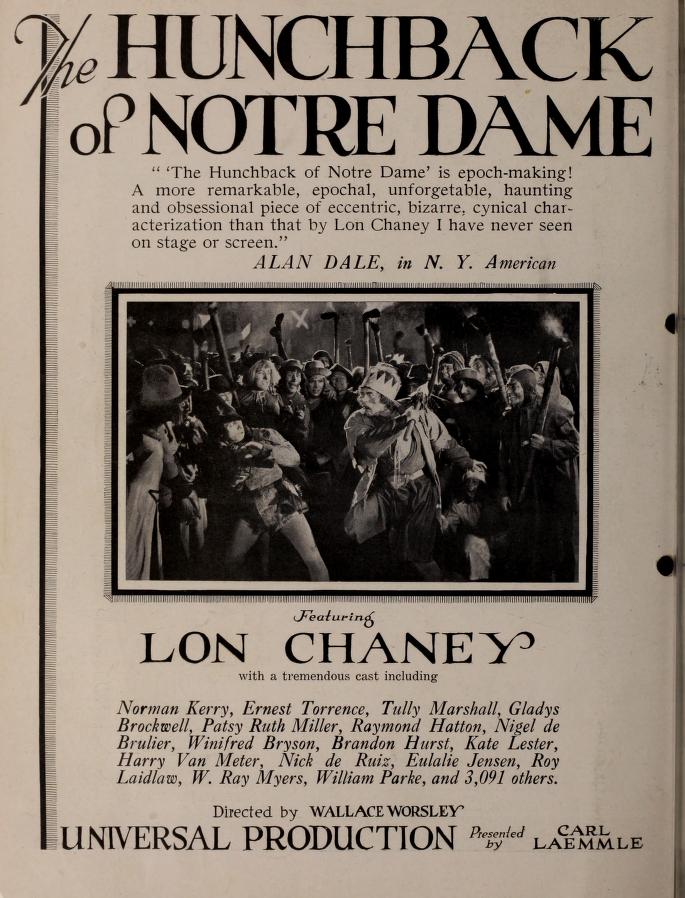


Lon Chaney
Lon Chaney


Scott Lord Silent Film: Lon Chaney inThe Phantom of the Opera (Jullian, 1925)


Author Mark A. Vieira, in Silent Prototypes, the first chapter of his volume “Hollywood Horror”, almost attributes an entire subgenre of “Gorilla movie”, or “man in a gorilla suit movies” to a 1912 novel written by Gaston Leroux entitled “Balaoo” which was filmed by Fox Studios during 1927, the creature being a “gorilla’s body and half a human head”. The film, which stars the very beautiful Leila Hyams, oddly enough is a lost film, of which the are presumed to be no surviving copies. It is interesting that author William Everson, in his volume Classics of the Horror Film, as early as 1974 wrote that "The Wizard" (six reels), directed by Richard Rossen, was in fact "the most fascinating, elusive and sought after of all 'lost' horror films." Everson includes a still phtotgraph of Edward Lowe being menaced by the ape, almost reminiscient of the many poliferated still photographs of Chaney from "London After Midnight" that seem to makes us feel the film is an apparition rather than the apparition is being filmed. Everson almost chides the studio's projectionist with , "the original film is probably gone beyond recall" and with the film being "sorely missed as a major gap in our knowledge".
Gaston Leroux created the fictional detective Joseph Rouletabile, who appeared in one of the earliest locked room mysteries, “The Mystery of the Yellow Room” (1907) and “The Perfume of the Lady in Black” (1908). Novelist Gaston Leroux had published “The Phantom of the Opera” in 1911.
Author Robert Gordon Anderson, in his volume Faces, forms, films; the artistry of Lon Chaney, chronicles the shooting of "The Phantom of the Opera" as having started in late 1924. "It had taken about ten weeks to do, although another eight months were spent in re-shooting some scenes, which were deleted in the final version."
During his early carrer at Universal Studios, Lon Chaney had most frequently appeared on screen under the direction of either Allan Dwan or Joseph De Grasse. Rupert Julian had not only directed but had also starred with Lon Chaney in the film "The Kaiser, The Beast of Berlin" (seven reels), made by the Universal Film Manufacturing Company during 1918. Apearing in the film with Julian and Chaney were actresses Betty Carpenter, Ruth Clifford and Gretchen Lederer. Lon Chaney
Lon Chaney
The Hunchback of Notre Dame
Silent Horror
Scott Lord Mystery: The Mystic (Tod Browning, 1926)
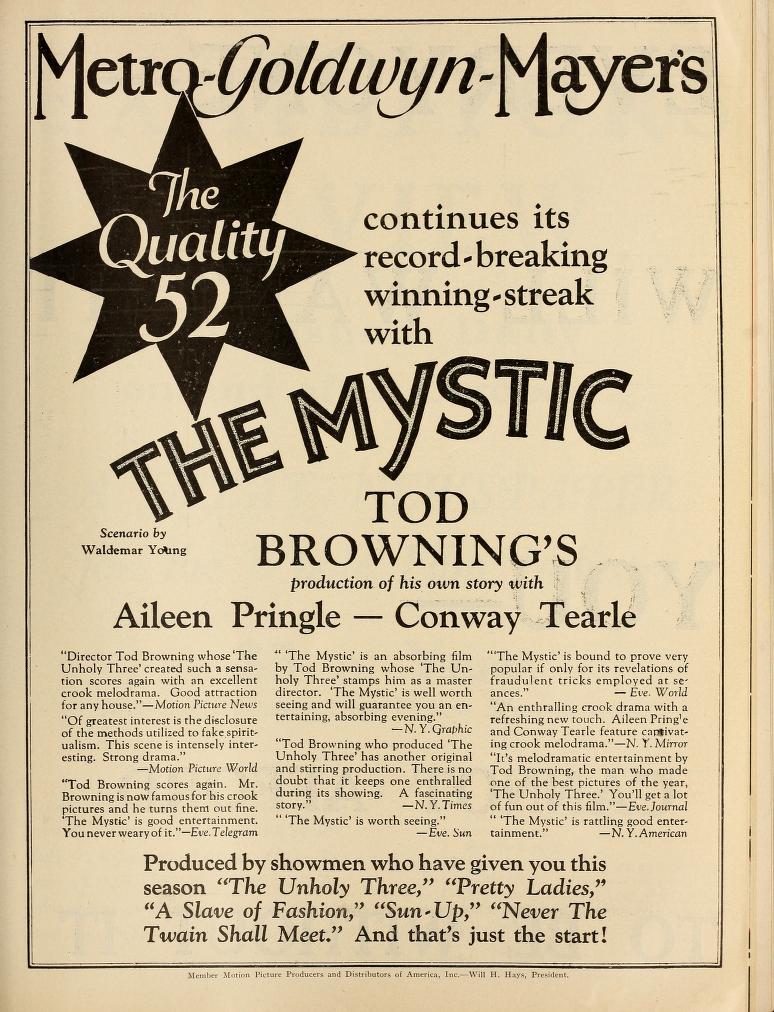


Sunday, October 5, 2025
Scott Lord Silent Film: Gosta Ekman in Faust (F.W. Murnau, 1926)

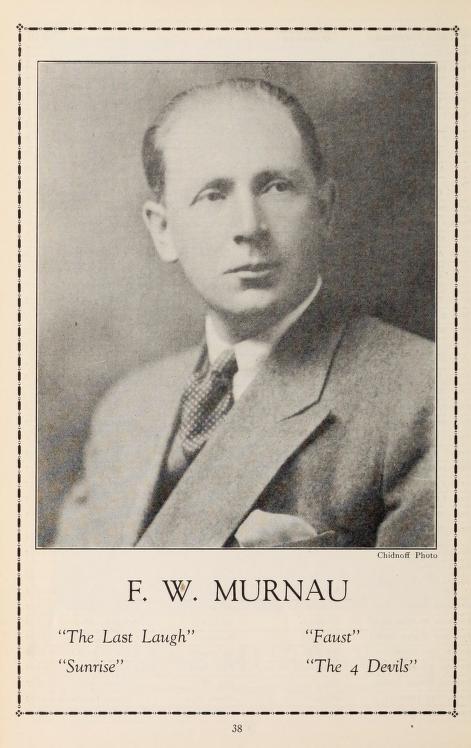
The immanent departure of Silent Horror Film director F.W. Murnau for America had already been announced by the periodical Motion Picture News during late 1925 while Murnau was readying the film "Faust". It was to star Gosta Ekman, "a young Swedish actor who has the title role. He has been a star on the legitimate stage and is now making his first appearance in pictures." Scholar Janet Bergstrom, University of California notes that F.W Murnau had recieced a letter from William Fox during 1925 prompted by the success of "The Last Laugh" (Der Letze Mann) and had already signed a contract to leave for America while filming "Faust" and "Tartuffe".
Janet Bergstrom, University of California , writes that with the film "Faust", among others, Murnau had "unchained the camera" with moving shots that seemed unique...sweeping the audience's emotions with them". Of these moving shots, Bergstrom brings to our attention tracking shots that were photographed above their subject by having rails mounted on the ceiling of the studio.
The use of a mobile camera by Murnau is clearly referred to by Robert Herlth, a designer of sets on the film "Faust", who wrote on the lighting of the film in a chapter entitled "With Murnau on the Set" included in the volume Murnau, published by Lotte H. Eisner. The set designer quotes Murnau as having said, " 'Now how are we going to get the effect of the design? This is too light. Everything must be made much more shadowy.' And so all four of us set about to trying to cut the light...We used them (screens) to define space and create shadows on the wall and in the air. For Murnau, the lighting became part of the actual directing of the film.'"
The periodical Photoplay Magazine during 1927 explained that F.W. Murnau had again resorted to literary adaptation for subject matter, "Goethe's panaoramic poem has been used as its basis and the adaptation was folowed, in the main, as closely as the screen permits...Murnau has caught the medieval atmosphere with suprising success." F.W. Murnau had actually jotted Goethe's name on one of his shootingscripts. Lotte H. Eisner, in his volume Murnau, writes that the script for "Faust", written by poet Hans Kyser, had originally contained a Walpurgisnacht, which may have only reluctantly have been elimanted from a script annotated by the director Murnau in order to "translate the text into visual terms and give directions to actors in terms ofimages."
In regard to whether F.W. Murnau was only on the peripheral of German Expression by definition due to its origins, one idea that supports that if anything F.W. Murnau held that peripheral is the adverse reaction of author Paul Rotha to the subsquent films Murnau made after haveing come to the United States to film. Rotha, in his volume The Film till Now: survey of world cinema, writes, "I find it impossible to accept that the Murnau who made 'Faust' and 'The Last Laugh' are the same man who made 'Sunrise' and 'Four Devils'. Some link between the two pairs of films is sought in vain. They seem the work of seperate persons: the first of an artist working with sincerity among harmonious surroundings; the second of a psuedo artist muddling under extreme difficulties of superabundance." There is a similar discorse concerning the films Swedish silent film director Victor Sjostrom made in Hollywood after having left Svenska Bio, yet it is one that recognizes the film technique od Sjostrom, including the use of ciematic devices such as cutting across the line to a reverse angle and flashbacks.
silent film
Silent Horror Film
Silent Horror
Wednesday, September 24, 2025
Scott Lord Silent Film: Lili Dagover in The Cabinet of Dr. Caligari (Rob...


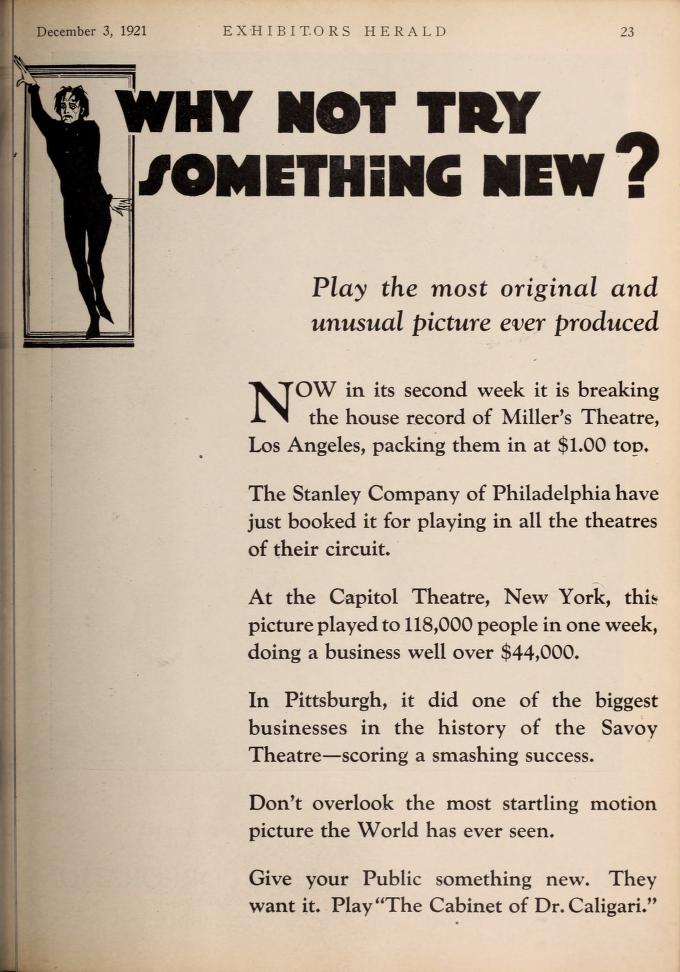
Wednesday, May 3, 2023
Scott Lord Silent Film: Dr Jekyll and Mr Hyde 1920
Author Mark A Vieira, in Silent Prototypes, the first chapter of his volume Hollywood Horror, includes John Barrymore as titular Dr. Jeckyll and Mr. Hyde as being a portrayl that was the first Hollywood silent horror film, but only as an atypical exception, his crediting The Phantom of the Opera with beginning the genre outright. "No studio wanted to alienate a public satiated with adventure, melodrama and romance. Even mysteries had did not ensure a box office success."
Directed by John S. Robertson, the photoplay was scripted by Clara Beranger and photographed by Roy F. Overrbaugh. Actresses Martha Mansfield and Nita Naldi star with John Barrymore in the film.
Silent Film
John Barrymore
Saturday, January 28, 2023
Scott Lord Silent Film: One Exciting Night (D. W. Griffith, 1922)
The photographer to the film “One Exciting Night” was Hendrik Sartov.
After having directed Carol Dempster in “One Exciting Night” (Eleven reels), D.W. Griffith, by then having become a producer for United Artists, followed in 1922 by directing Dempster in the film “The White Rose” (twelve reels) with actress Mae Marsh.


Silent Film
Silent Film
Silent Film
Silent Film
Friday, December 9, 2022
Scott Lord Silent Film: The Last Performance (Paul Frejos, 1929)
The stockmarket had apparently already crashed by the time "The Last Performance", starring Conrad Veidt and Mary Philbin, was screened first run at the Park Theatre in Boston. Universal Weekly, primarily an advertising journal, after having remarked the film was "conspicuous for its camera effects and discriminating direction" tied in the New England premiere to its reception by excerpting three "leading newspapers", The Boston Globe, The Boston Herald and the Daily Record. The Daily Record mentioned the film as having been one of the two "first rate pictures" then on the marquee of the Park Theatre, the other also produced by Universal. It may be important to the history of film appreciation that the paper had written, "The Philbin-Veidt is part talkie. But in some cases, the less talk, the better the picture. This is one of those cases, for Veidt is a high rating character actor and needs no dialogue to score his points."
An earlier issue of Universal Weekly, while noting that Conrad Veidt and Mary Philbin had previously costarred together in the film "The Man Who Laughs", showed the trick photography in the film "The Last Performance" by providing a still from the film where the magician Veidt is holding Philbin in his hand. The Universal Weekly, owned by Universal Pictures Corporation, clarified itself with its captioned subtitle, "A Magazine for Motion Picture Exhibitors" and listed its editor as Paul Gulick. Letters to the editor to be published were addressed to Carl Laemmle, President. Interestingly, Author Anthony Slide gives an account of Mary Philbin having declined interviews after retirement, "Thanks to her reclusivity, she became a minor Garbo in the eyes of fans of silent film."
Silent Film Lon Chaney Bela Lugosi
Monday, December 5, 2022
Scott Lord SIlent Film: Wax Works (Paul Leni, 1924)
Paul Leni directed the expressionistic film "Wax Works" before coming to America to direct the films "The Cat and the Canary" and "The Last Warning".
Leni had worked as an art director with director Leopold Jessner on the film "Backstairs" (Hintertroppe, 1921), an "intimate drama" (Eisner) that moved "at a very slow, heavy pace" (Eisner).
Silent Film
Sunday, September 30, 2018
Subscribe to:
Posts (Atom)