
Scott Lord on the Silent Film of Greta Garbo, Mauritz Stiller, Victor Sjostrom as Victor Seastrom, John Brunius, Gustaf Molander - the Golden Age of Swedish Silent Film........Lost Films in Found Magazines: Victor Seastrom directing John Gilbert and Lon Chaney, the printed word offering clues to deteriorated celluloid, extratextual discourse illustrating how novels were adapted to the screen; the photoplay as a literature, a social phenomenon; how it was reviewed, audience reception.
Scott Lord on Silent Film

Gendered spectatorship notwithstanding, in a way, the girl coming down the stairs is symbolic of the lost film itself, the unattainable She, idealized beauty antiquated (albeit it being the beginning of Modernism), with the film detective catching a glimpse of the extratextural discourse of periodicals and publicity stills concerning Lost Films, Found Magazines
Showing posts with label Silent Film 1923. Show all posts
Showing posts with label Silent Film 1923. Show all posts
Friday, February 20, 2026
Scott Lord Silent Film: (Hårda viljor (John Brunius, 1923)
Directed by John Brunius in 1923 with a screenplay coscripted Sam Ask, "Harda Viljor" starred actresses Lilla Bye and Linnea Hillberg. The film was photographed by Hugo Edlund.
Silent Film
Silent Film
 Scott Lord on Silent Film, Scott Lord on Swedish Silent Film, Scott Lord on Danish Silent Film
Thursday, February 5, 2026
Nedbrudt nerven/The Hill Park Mystery (A. W. Sandberg, 1923)
Thomas C. Christenson, Who was kind enough to write to me from the Danish Film Institute last year, in his articles Restoration of Danish Silent Films: In Colour and Restoring a Danish Silent Film: Nedbrute Nerver writes about the restoration of what he deems to be “a comic mystery plot set in contemporary time in an unnamed Western country.” Nordisk Film Kompagni title books were used in the restoration to augment the original nitrate print.
Starring in "The Hill Park Mystery" was actress Olga d'Org, the photoplay having been written by Laurids Skands.
During 1924, Anders W. Sandberg showcased both Karina Bell and Karen Casperson in the film "House of Shadows" (Moraenen), photographed by Chresten Jourgensen, the photoplay written by Laurids Skandis.
A.W. Sandberg, notably at a time when Denmark was looking for foreign markets to which to export Film to quell an economic crisis caused by competion from Hollywood, gained recognition as a director by adapting the works of Charles Dickens, including “Our Mutual Friend” (1921), starring Karen Caspersen, ”Great Expectations” (1922), starring Olga d'Org, “David Copperfield” (1922) and “Little Dorritt” (1924), starring Karina Bell and Karen Winther. Peter Cowie, in his volume Scandinavian Cinema, writes that Anders Wilhelm Sanders had chosen Dickens because of his "fondness of emotional drama". Forsyth Hardy, in his volume Scandinavian Film writes, "These films had some success in Scandinavia where their wistful sentimentality had an appeal, but for audiences in Britain and America they failed to capture the essential flavor of Dickens' work."
Danish Silent Film
A.W. Sandberg
Scott Lord on Silent Film, Scott Lord on Swedish Silent Film, Scott Lord on Danish Silent Film
Saturday, January 31, 2026
Swedish Silent Film: (The Hell Ship 1923, Victor Sjostrom)
The 1923 film "The Hellship" (Eld Omboard), directed by Victor Sjostrom and co-scripted by Victor Sjostrom and Hjalmer Bergman, starred actresses Jenny Hasselqvist, Julia Cederblad and Wanda Rothgardt. The cinematographer of the film was Julius Jaenzon.
Victor Seastrom
Victor Seastrom Victor Sjostrom
Victor Seastrom
Victor Seastrom Victor Sjostrom
Scott Lord on Silent Film, Scott Lord on Swedish Silent Film, Scott Lord on Danish Silent Film
Monday, December 22, 2025
Scott Lord Silent Film: Blanche Sweet in Anna Christie (John Griffith Wray, 1923)


During 1923 actress Blanche Sweet also appeared in the film "In the Palace of the King" directed by Emmett J. Flynn and written by June Mathis. The film is presumed to be lost, with no surviving copies existing. During 1924, actress Blanche Sweet appeared under the direction of Lambert Hillyer for Thomas Ince Productions, Incorporated in the eight reel film "Those Who Dance". The film is presumed lost, with no surviving copies existing. Lambert Hillyer cowrote the photoplay with Arthur Statter.
 Scott Lord on Silent Film, Scott Lord on Swedish Silent Film, Scott Lord on Danish Silent Film
Saturday, October 4, 2025
Scott Lord Silent Film: Silent Command (J.Gordon Edwards,1923)
Its first run having coincided with Lon Chaney having appeared on theater marquees while starring in The Hunchback of Notre Dame, "The Silent Command", directed by J. Gordon Edwards during 1923, starred the relatively unknown actor Bela Lugosi. With actresses Alma Tell, Martha Mansfield and Florence Martin, the periodical Photoplay Magazine offered its review as near hyperbole, "Betty Jewel is the prettiest thing in the cast."
Lon Chaney Lon Chaney
Lon Chaney Lon Chaney
Scott Lord on Silent Film, Scott Lord on Swedish Silent Film, Scott Lord on Danish Silent Film
Scott Lord Silent Film: Carol Dempster in The White Rose (D.W. Griffith, 1923)


D.W. Griffith
Silent Film
Scott Lord on Silent Film, Scott Lord on Swedish Silent Film, Scott Lord on Danish Silent Film
Scott Lord Silent Film: Broken Hearts of Broadway (Irving Cummings, 1923)


 Scott Lord on Silent Film, Scott Lord on Swedish Silent Film, Scott Lord on Danish Silent Film
Saturday, August 2, 2025
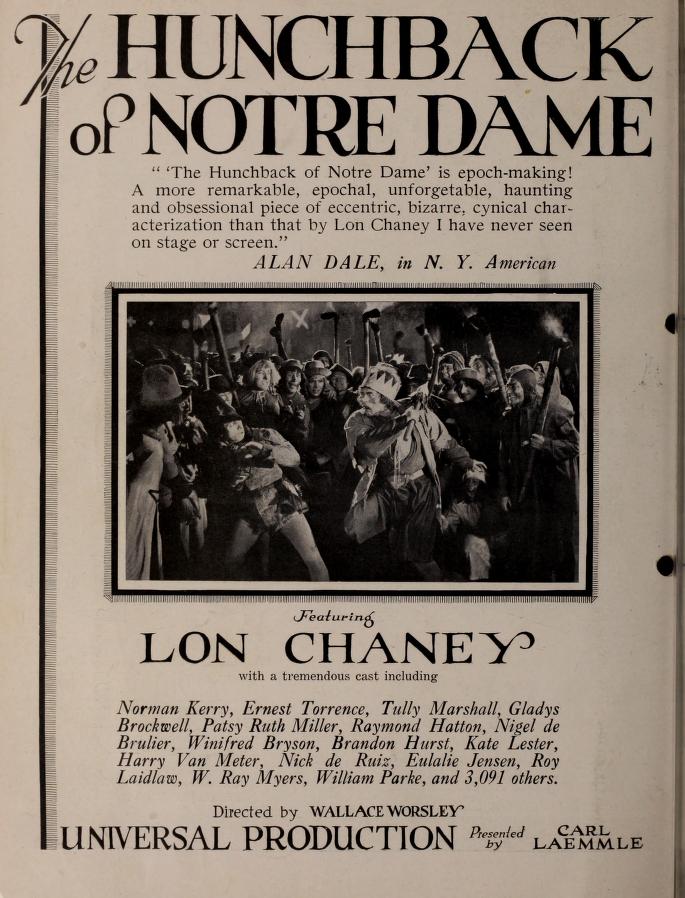
Scott Lord Silent Film: Lon Chaney in The Hunchback of Notre Dame (Worsley, 1923)
Prior to having directed Lon Chaney in the twelve reel silent film “The Hunchback of Notre Dame, Wallace Worsely had been behind the camera for the films “The Penalty” (1920” and “The Ace of Hearts” (1921), both films having feature the Man of a Thousand Faces.
Moving Picture World magazine during 1924 deemed "The Hunchback Of Notre Dame" to be a "spectacle drama". Film Daily included the Cathedral in a photolayout espousing "The Value of Large Sets" during 1926, claiming that Universal had reproduced 20 blocks of medieval France while making the film.
Author Mark A Vieira, in Silent Protypes, a chapter in his volume Hollywood Horror, christens "The Hunchback of Notre Dame" as the "Birth of the Monster", the first film made in the genre. Suprisingly, Vieira follows Lon Chaney to the newly formed merger of Metro-Goldwyn-Mayer and Irving Thalberg. Lon Chaney had starred with John Gilbert and Norma Shearer in the first feature made at M.G.M directed by Victor Sjostrom, formerly known in Sweden as Victor Sjostrom. While author Robert Anderson, in his 1971 volume Faces, Forms, Films, the artistry of Lon Chaney, claims that "in most of the Browning-Chaney films the plot evolved from the characterization", author Mark A.Vieira also gives Chaney credit for creating a new and original character with each new manifestation of make-up; each new character is automatically placed in an entirely different narrative based on Chaney's physical appearance. Vieira follows Chaney back to Universal and The Phantom of the Opera (Rupert Julian, 1925).
Interestingly, Journalist Tom Wilson, in the Allegheny City Society Reporter Dispatch. intimates that silent film director Lois Weber while at Universal had been a "script doctor" on the film "The Hunchback od Notre Dame", the photoplay having been adapted from the novel by Edward Lowe and Perley Poore Sheehan. Lowe, previously a revising editor ar Essanay, had co-written the photoplay to the film adapation of "Under Two Flags" (Tod Browning,1922).

The novel "The Hunchback of Notre Dame by Victor Hugo had previously been filmed during 1906. Director J. Gordon Edwards adapted the novel to the screen during 1917 in a six reel production titled "The Darling of Paris" for Fox Film Corporation starring actress Theda Bara. The film is presumed lost with no existing copies. The synopsis of "The Darling of Paris" given by the periodical Motography during 1917 prooves the film to be a faithful adaptation of the story of Esmerelda and Quasimodo. It reviewed the performance of Theda Bara in the lost film, "The part taken by Theda Bara in'The Darling of Paris' is one of the most interesting characters she has been called upon to interpret since she has been in the silent drama. It is an unusual one, dominating the story beginning to end. There are but few moments when she is not in the picture, which adds to the importance of the production." The periodical Moving Picture World described the film, "To anyone not familiar with the Hugo romance, the Fox screen version presents a well put together photoplay, rich in picturesque incident, strong character drawing, authentic reproduction of an age long past, dramatic situations in abundence, and a climav of thrilling worth."



Lon Chaney
Lon Chaney


 Scott Lord on Silent Film, Scott Lord on Swedish Silent Film, Scott Lord on Danish Silent Film
Wednesday, February 16, 2022
Scott Lord Silent Film: Mary Pickford in Rosita (Ernst Lubitsch, 1923)


 Scott Lord on Silent Film, Scott Lord on Swedish Silent Film, Scott Lord on Danish Silent Film
Saturday, July 13, 2019
Scott Lord Silent Film: Scaramouche (Rex Ingram, 1923)


 Scott Lord on Silent Film, Scott Lord on Swedish Silent Film, Scott Lord on Danish Silent Film
Thursday, August 2, 2018
Scott Lord Silent Film: Felix in Hollywood (1923)
 Scott Lord on Silent Film, Scott Lord on Swedish Silent Film, Scott Lord on Danish Silent Film
Subscribe to:
Comments (Atom)